
Inside Randolph County Tax Records
Randolph County property tax records work in two connected halves. The assessment side values the land and its improvements. The collection side tracks the bill and any balance due. The Revenue Commissioner reports an inventory of roughly 36,500 parcels. Each parcel has its own property record card. Land and buildings are described and valued separately. That split helps an owner in Randolph County. The owner can tell whether a change came from the site itself or from an improvement.
| Tax field | Meaning in the record | Official source |
|---|---|---|
| Fair market or appraised value | Full valuation basis before the property class percentage | Revenue property record card |
| Assessed value | Appraised value multiplied by the Alabama classification rate | Revenue assessment record |
| Land and improvements | Separate characteristics and values for the site and buildings | Revenue property record card |
| Exemptions | Approved homestead or current-use treatment affecting tax | Property Assessment Division |
| Bill and payment status | Tax due, payment channel, and delinquency status | Revenue tax account |
These figures answer different questions. Assessed value feeds a tax calculation. It is not a predicted selling price, and a deed's consideration stands apart as a separate recorded fact. The county's sales-ratio statement of 98% to 102% measures equalization across a valuation zone, and it never promises that a Randolph County parcel will trade at the figure on its card.
Randolph County Assessment Math
Alabama's property classes convert appraised value into assessed value. Randolph County applies 30% to Class 1 utility property. Class 2 property sits at 20%. Class 3 covers farm, owner-occupied residential, and qualifying National Register property at 10%, while Class 4 motor vehicles carry 15%. Multiply the appraised value by the class rate for the assessed value, and the levy then applies to that amount.
- Appraised value
- The county's fair market valuation basis.
- Assessed value
- The appraised value after the class rate is applied.
- Levy or mill rate
- The tax rate applied to assessed value.
- Tax lien
- A public claim tied to unpaid property tax.
Classification can matter as much as a fresh appraisal. Before rebuilding a bill from one number, ask Revenue which class appears on the current card.
Randolph County's Annual Tax Clock
Randolph County works on an annual tax clock. The county values each parcel using its state-approved status from September 30 of the prior year. Ownership and assessment status then flip on October 1. Taxes come due October 1 and turn delinquent after December 31. The county collects in arrears. A tax notice is only a courtesy. A bill that never arrives does not erase what is owed.
That schedule explains a common surprise for buyers. A tax bill can arrive bearing the prior owner's name. The annual tax roll has not caught up with the sale. The county's position is that the buyer owes the tax. The buyer should not wait for a corrected bill. Keep the closing date, the deed recording details, and the assessment-return date handy. Then ask the Revenue office to reconcile the record.
Note: Ask your mortgage company directly whether it will pay an escrowed bill, not just assume the account is settled.
Look Up Randolph County Tax
The Randolph County Revenue Commissioner links both the parcel viewer and online payment services. Start with the street address. Keep the parcel number once it appears. Live search labels may differ. If the portal returns no usable account, call Revenue at 256-357-4343 or write to P.O. Box 310, Wedowee, AL 36278.
- Use the county-linked parcel viewer to identify the correct parcel from the address.
- Open Revenue online payments and follow its property-tax route.
- Match the parcel and tax year before reading the balance or payment status.
- Compare the assessment card with the bill, including classification and approved exemptions.
- Call Revenue when a prior owner, unclear year, or delinquent balance makes the result uncertain.
In person, the county accepts cash, check, money order, and Visa or Mastercard. Mail payments go to Tammy Farr at the Revenue address. Online options cost more. Card, debit, and e-check payments carry $2.50 or 2.5%. The county charges whichever is greater. A receipt proves payment, not title.
The ING Property portal serves as the county's route for payments and account lookups.
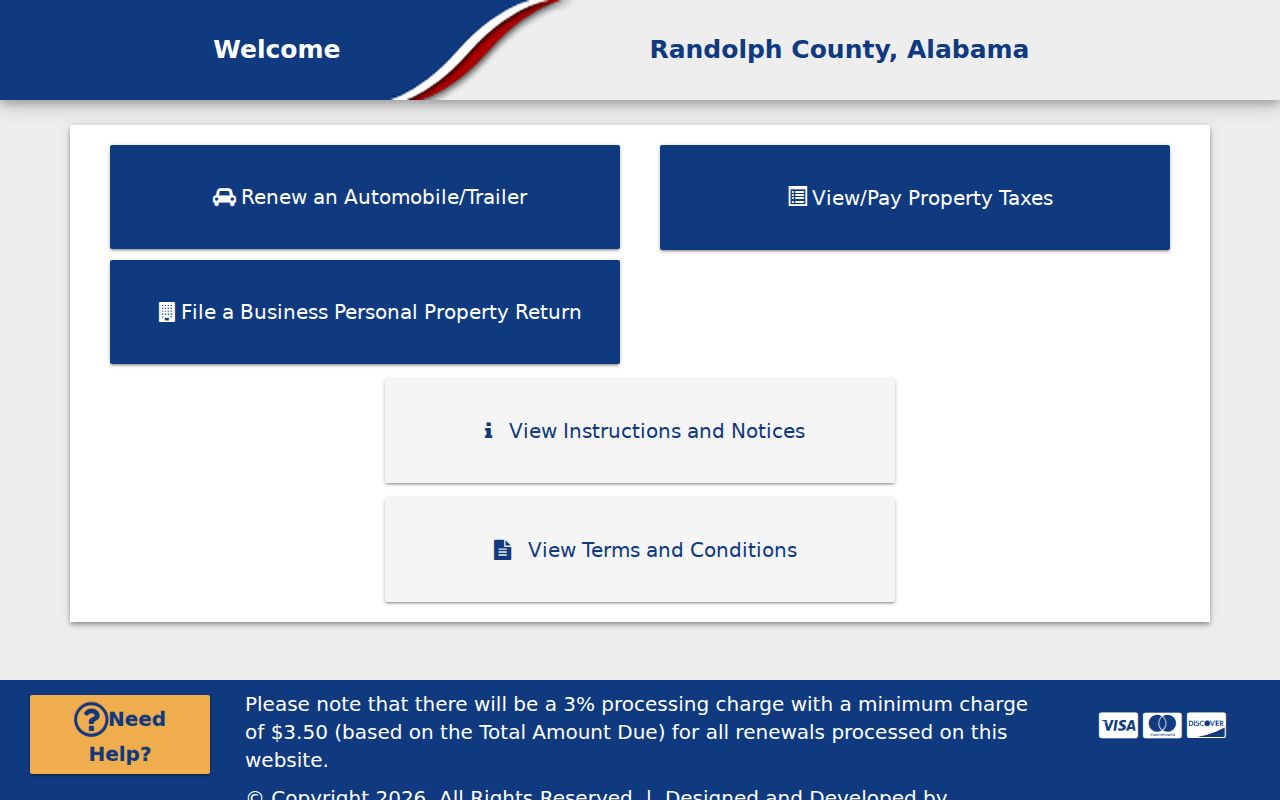
The portal is the county's official payment destination. Field labels and results should be confirmed in the live session before anyone relies on them.
Randolph County Tax Exemptions
Exemptions change the taxable result, not the deed. Record the deed with Probate first. Then comes an assessment return and any homestead claim with the Property Assessment Division. Randolph County generally sets December 31 as the filing point for the following tax year. File again whenever the deed or occupancy changes.
The county describes H-1 for an owner-occupied single-family home, including a qualifying manufactured home, with $4,000 of state and $2,000 of county assessed-value exemptions. H-2, H-3, and H-4 are different animals. Each has distinct rules tied to age, disability, blindness, income, and the tax portion involved. Current use is separate again. That treatment can apply to qualifying farm, pasture, or timber land. A new owner must re-file. A use change may trigger revaluation and three years of recapture under Alabama Code §40-7-25.3.
Do not read H-2 through H-4 as one broad senior exemption, because the county material separates age, total disability, blind status, adjusted gross income, state portions, county portions, proof, and annual verification. It lists a $12,000 adjusted-gross-income threshold for certain categories. H-4 also carries a county portion limit. Those details decide which relief applies even between owners of the same age. Take current proof to Revenue. Ask which rule fits this deed and use. Copying the former owner's exemption from an old tax card can mislead, because exemptions do not automatically follow every transfer.
Improvements in Randolph Tax Records
Building an addition is one thing under tax law and another under local permitting. The Revenue Department asks owners to report new work by December 31. The list covers new structures, additions, pools, extensive repairs, fireplaces, baths, patios, decks, carports, and garages. Painting, re-roofing, and normal upkeep sit on the county's non-reportable list instead. So a Randolph County property records search can turn up surprises. Improvements may appear that never crossed a permit counter anywhere.
Location drives the permit side. Randolph County publishes no general zoning or building-permit program for unincorporated land. Municipal parcels fall to the city or town. The County Engineer takes subdivision, floodplain, and logging questions. That split explains the confusion. A tax card and a city zoning file often describe the same land differently.
A value can shift after work on the parcel. Read the card's land and building entries rather than the total alone. The Revenue description values those parts separately. Note the improvement description and the assessment year, then set it beside the work actually reported. A thin or missing building description is a reason to call appraisal staff. It is not grounds to invent a substitute figure. Keep receipts, dated photographs, plans, and any municipal record that describes the work accurately. They help pin down a factual issue if the annual notice ever needs review.
Randolph County Delinquent Tax Checks
A tax account past its due date can carry consequences well beyond a routine balance. Randolph County publishes no current tax-sale calendar. It also posts no static online delinquency field. So an old bill or a portal error proves nothing about a pending sale. Confirm the year, balance, and status with Revenue first.
Court records matter once a dispute reaches litigation, but they never replace the tax account. The Randolph Circuit Clerk and Alabama's Just One Look system offer court-record routes where a case is available. For Commission records outside Revenue's custody, Alabama residents can use the county's open-record form in person. Probate deeds, Revenue cards, and tax accounts still belong with their actual custodians.
Ask Revenue for a status tied to the exact parcel and tax year. A paid current year says nothing about an older one. A deed search, likewise, never shows the live collection balance. Save the date of the portal view. Save the payment confirmation and the name on the account. If a tax-sale question comes up, request the present official schedule and procedure instead of trusting an undated list. County material lists due and delinquency dates. But a current sale list, redemption calculation, or auction date must come from the custodian's own response.
Contest a Randolph County Assessment
A value-change notice starts the local review clock. The owner files a written appeal with the Randolph County Board of Equalization. The appeal should identify the parcel, the disputed value, and the facts supporting a correction. Strong evidence might include the current property record card and photographs. Building facts, a qualified appraisal, and comparable sales matched to similar property also help. Ask Revenue how to deliver the writing and when the Board sits. The annual session runs on newspaper notice, and no standalone form exists.
The Board can lower, raise, or leave the value as is. Its result arrives by mail. A further Circuit Court appeal carries its own 30-day window. The county also requires taxes paid by December 31. Alternatively, a bond for double the taxes must be posted, to keep the appeal alive. These deadlines are strict, and none of them touch ownership disputes in a deed.
Watch the notice date. A written Board of Equalization appeal is due within 30 days of the annual value-change notice.