
Start a Randolph Property Search
Pick your starting office by the fact you already have. An address works best in the parcel viewer or with the Revenue Commissioner. An owner name can be tested against the assessment roll first. It can then be searched in Probate as both grantor and grantee. A book and page citation goes straight to the recorded-document index. Revenue is the right stop for tax balances and payment history.
Keep the sources separate in your notes. An assessment listing can lag behind a freshly recorded deed. A paid tax bill proves nothing about title. A GIS line is never a survey. Save the year, date, office, URL, and identifier for each property record. That way the trail can be retraced later.
- Confirm the county, municipality, and situs address rather than relying on the mailing city or ZIP alone.
- Find the assessment parcel lead and copy the parcel ID, owner label, legal description, and record year.
- Search Probate for deeds, plats, mortgages, releases, liens, and cross-references under the indexed names.
- Check tax status and the map separately; neither one replaces the recorded instrument.
- Request a plain or certified copy from the custodian when the image or older index is not online.
Randolph County Records Custodians
Randolph County property records have no single home. Probate holds the land recordings. The Revenue Commissioner runs assessment and property-tax functions and links the public parcel viewer. Buyers also file assessment returns with Revenue after a purchase. Commission open-record requests follow their own process. So treat them as a last resort rather than a catchall for records that belong to Probate, Revenue, or a town office.
Randolph County Revenue Commissioner
County courthouse
Wedowee, AL 36278
256-357-4343
Randolph's Online Deed Index
The ING Probate Randolph portal is the county's online door to its land-record index. The official instructions support searches by name, date range, book and page, role, Starts With, and instrument type. They also cover role. Instrument type matters too. Separate views exist for grantor, grantee, assignee, and all names. These make it easier to tell true transfers from assignments. Searching requires an account, and document images are sold through a purchase cart. Check the portal for current image prices and the earliest year of coverage.
Visit the official Probate portal to run your own deed records search.
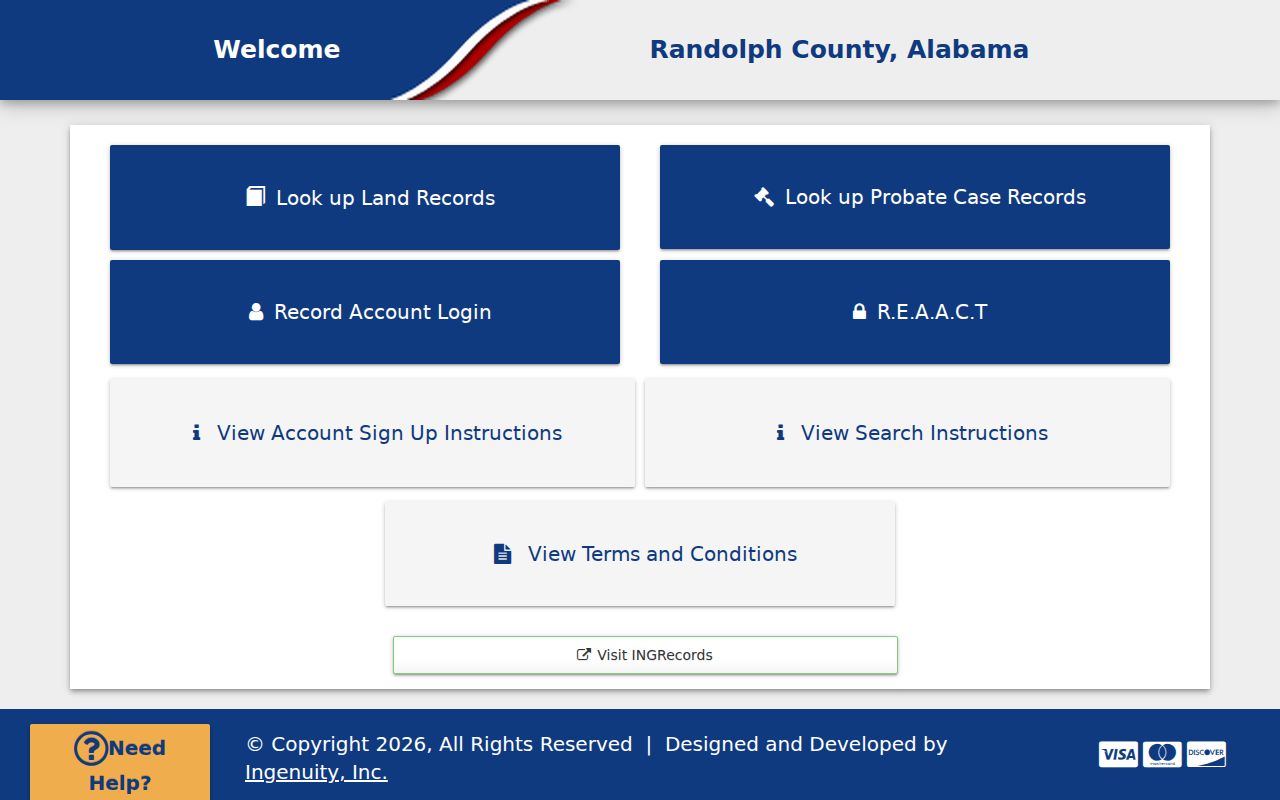
The portal is the right route into the index. A live search is still needed to confirm exact columns, coverage years, and image access for specific volumes.
Randolph Parcel Cards and Values
Randolph County tracks roughly 36,500 parcels, the Revenue Commissioner reports. Every parcel carries a property record card. The card lists land and building characteristics separately and values each part on its own. Values run on an annual calendar. State-approved valuation status dates to September 30. Ownership and tax status follow October 1. A buyer who records the deed keeps the card current. Filing an assessment return promptly does too.
Revenue publishes Alabama's classification percentages. Class 1 utility property sits at 30%, Class 2 at 20%, qualifying Class 3 property at 10%, and Class 4 motor vehicles at 15%. Multiply the appraised value by the class percentage. The result is the assessed value on the tax roll. These percentages explain the roll; they do not prove what a parcel would sell for.
Randolph County Parcel Viewer
The county Revenue site links the Randolph County Online Parcel Viewer, and Flagship publishes desktop and mobile entry points. The viewer's exact search labels, parcel ID format, layer list, adjacent-parcel tools, and export options vary by release, so rely on the controls the map itself displays.
Open the official parcel viewer to search the county's GIS map yourself.
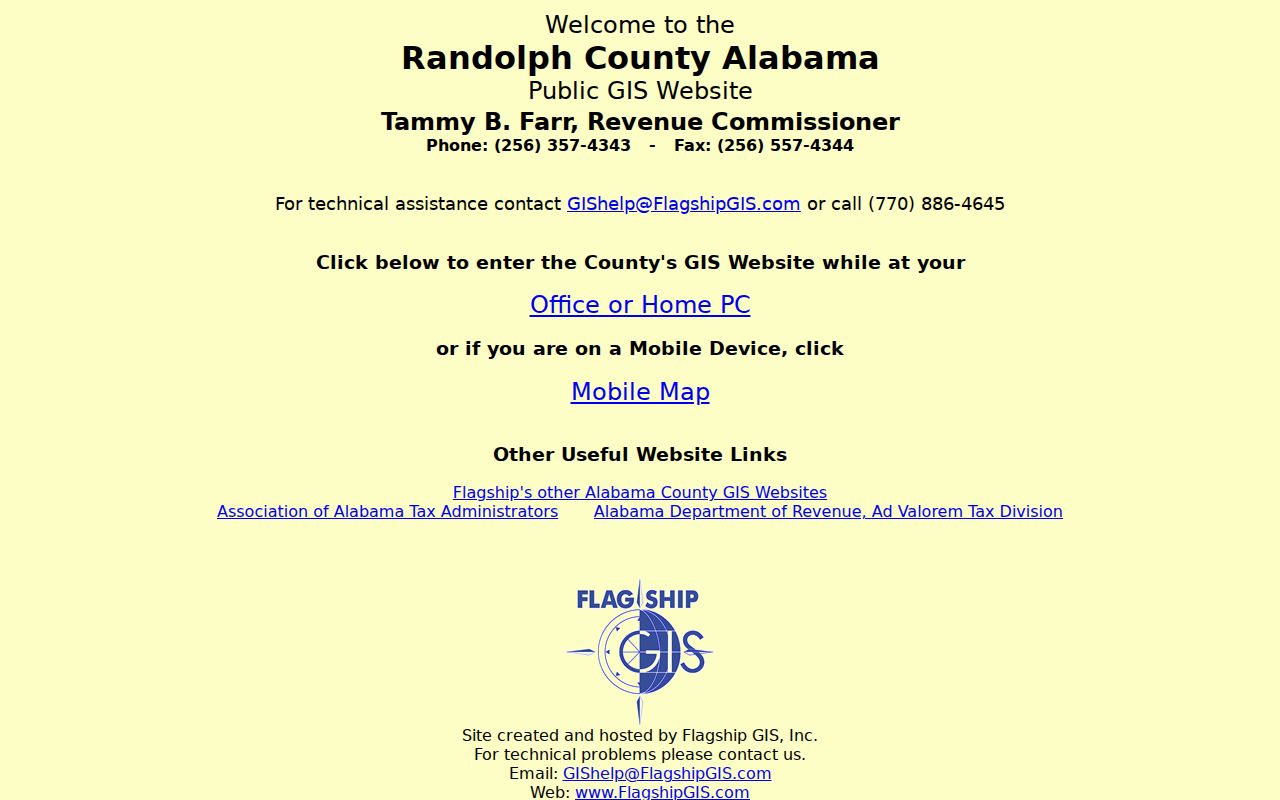
The map marks the official parcel-viewer entry point for the county. It does not certify boundary accuracy or reveal the contents of any parcel card.
Randolph Property Tax Timing
Randolph County property taxes are due October 1. They turn delinquent after December 31 or January 1. Pay in person, by mail, or online with a card, debit, or e-check. The online convenience fee runs $2.50 or 2.5%, whichever is greater. A receipt proves you paid, not that you own.
The county warns that a tax bill can stay in a prior owner's name after a sale. The buyer carries responsibility for the year while that name is unchanged. That annual-roll mismatch is a good reason to weigh Revenue data against the newest recorded deed. Exemptions, assessment returns, and improvement reports each follow separate filing rules.
Randolph City and County Rules
Randolph County's 2025 zoning and permitting guidance states that the County Commission has no legal zoning authority, and it identifies no general county zoning restrictions or adopted building-permit program outside municipal limits and police jurisdictions. That does not leave land unregulated. State building rules, floodplain rules, septic, environmental, and utility requirements can still apply to a parcel.
Inside Roanoke, Wedowee, Wadley, or Woodland, go to the municipality. Roanoke publishes a zoning ordinance and map, and Wadley has a 2024 amended zoning ordinance. Confirm the municipality from the parcel record itself, never from the mailing city alone.
Randolph Records Survived Fire
Older research in Randolph County benefits from a bit of history. County records say the 1898 courthouse burned in August 1940. A fireproof vault installed in 1937 reportedly saved most of the records. The replacement courthouse opened in 1941. Do not assume the fire destroyed everything.
When the online deed index runs dry, ask Probate about its physical deed and plat indexes. The vault holdings span more than you might expect. The Alabama Archives Randolph finding aid covers county and town history files. FamilySearch holds statewide deed and probate collections. Broad date ranges are no guarantee that a given Randolph volume is indexed or imaged.
Request Randolph County Records
Randolph County handles formal requests through its Commission open-records procedure. It follows the Alabama Open Records Act as amended by Act 2024-278. Only Alabama residents may file. The standard form asks for proof of residency. Submission happens in person at 12 East Broad Street Southeast in Wedowee. Be specific about what you want. Estimated administrative fees can also be demanded before any time-heavy search or release.
Custody decides where a request goes. Probate holds the deeds. Revenue keeps the assessment cards. Towns keep their own zoning files. The Commission form covers only records in Commission custody or control. It cannot retrieve every item among Randolph County property records. Match the document to its keeper first.
Check Randolph Access Notices
Access details shift at the courthouse and online. A county renovation notice placed the work between November 4, 2024 and December 2025. It directed visitors to the rear entrance at 5 First Street East as the main way in. Renovation posts describe a moment, though, not a permanent arrangement. Check current signage before you go.
The county home page also flagged a planned network outage for September 9, 2026. It was set to affect Mapping and Appraisal, property-tax payments, and Probate recording. If an official portal fails, keep the office phone handy. Read the county notice, and try again later. Skip unofficial mirrors entirely.
Randolph Property Record Types
Every record answers one narrow question. Deeds document recorded conveyances, while mortgages and liens reveal possible burdens on a parcel. Assessment cards carry valuation data, and tax accounts show whether a bill is current. Plats back up lot and block descriptions. Municipal files handle zoning and permits. The keeper of each document, and the route for getting it, must match the record itself.
| Record Type | What It Documents | Kept By | Access |
|---|---|---|---|
| Deeds | Recorded land transfers and legal descriptions | Probate Judge | Online index, document purchase, counter, mail |
| Mortgages and liens | Secured claims, assignments, releases, judgments | Probate Judge | Index and recorded documents |
| Assessment and tax | Land/building values, class, exemptions, bill status | Revenue Commissioner | Revenue office and online payment route |
| Plats and parcels | Recorded lot layout and tax-map orientation | Probate and Revenue/GIS | Index, counter, public viewer |
| Zoning and permits | Land-use status and local approvals | Municipality or routed county/state office | Office request; Roanoke publishes zoning material |
Two pages split the work cleanly. Recorded ownership questions go through the Randolph County deed records process, while bills and assessment rules live on the tax page. Plats and parcel lines answer different boundary questions, so treat neither as a substitute for the other.
Limits of Randolph Property Records
Official records answer many questions but not all of them. A search can identify an assessment name, a recorded grantee, values used for tax purposes, payment status, a legal description, and filed encumbrances. It cannot guarantee that every interest surfaced. Separate court, estate, correction, unrecorded, or misindexed matters can exist. Assessment value is not an appraisal of likely sale price either. A map highlight will not locate a fence or settle a boundary dispute.
Search the Probate index by role, not just name. A grantor conveys an interest, a grantee receives it, and an assignee may appear when a mortgage moves. Try initials, surname-first forms, married names, trusts, estates, and business suffixes. Starts With widens a prefix, though the index publishes no fuzzy matching. Save the instrument type, book/page or number, dates, indexed parties, description, cross-reference, image status, and search date. Search mortgages, assignments, releases, judgments, liens, and lis pendens apart from the deed. An old mortgage result does not prove the debt remains open.
Revenue works on an annual framework. Valuation status ties to September 30, while ownership and tax status use October 1. That timing can leave a bill in a prior owner's name after a deed is recorded. The county still treats the buyer as responsible and directs buyers to record the deed and file an assessment return. Save the deed date, recording reference, return date, and roll year. The county publishes no average lag figure.
Land and improvements carry separate values. Randolph County asks owners to report new structures, additions, pools, extensive repairs, fireplaces, baths, patios, decks, carports, and garages by December 31. Painting, re-roofing, and normal maintenance are non-reportable. Those rules can explain an assessment change, but they do not prove sale value. A deed's consideration and transfer tax are separate matters.
Homestead and current-use entries need owner-specific review. H-1 applies to a qualifying owner-occupied home, while H-2, H-3, and H-4 use separate age, disability, blind-status, income, proof, and renewal terms. Current use can apply to qualifying farm, pasture, or timber land. A new owner must re-file. A use change may bring revaluation plus three years of recapture.
A value-change notice opens a 30-day written appeal period to the Board of Equalization. The Board may lower, raise, or leave the value unchanged. A Circuit Court appeal carries another 30-day period. County guidance says taxes must be paid by December 31, or a double-tax bond posted, to preserve the appeal. The county publishes no current Board notice, tax-sale list, bidder method, or redemption guide.
Save GIS results field by field. Copy the exact owner label, mailing address, situs, parcel or account number, legal description, municipality, acreage, land value, improvement value, total, class, and tax year. Also copy any transfer fields actually shown. Record any update date; without one, treat the card as an undated roll snapshot. Never infer a neighbor's ownership from a label crossing a boundary.
Historic sources sharpen search terms but never replace a recording. The Archives offers a 1937 county highway map. Tallapoosa ferry routes, Wadley's railroad and Louina link, Roanoke's Lowell Mill Village and bypass, and Wedowee history can explain old names. FamilySearch's broad Alabama dates do not indicate which Randolph volumes are indexed or imaged. Record the county filter, volume, image status, and stopping point.
Outside municipal limits and police jurisdictions, the Commission holds no zoning authority and has not adopted a general county building-permit program. State building, floodplain, septic, environmental, and utility rules can still apply. New structures go to Revenue appraisal. Subdivision and floodplain questions go to the County Engineer. Septic goes to Randolph Health. Business licenses go to Probate.
Roanoke publishes a zoning ordinance and map, and its application asks for owner, address, Tax Map and Lot, size, zoning, and existing structures. Wadley has a 2024 amended ordinance. No searchable permit database exists for Wadley or Wedowee. Mailing city and ZIP do not settle jurisdiction. Confirm the situs and municipal boundary first.
Open-record requests depend on custody. The Commission process requires an Alabama resident to use the form, show residency proof, and submit it in person. Requests must be specific, and estimated administrative charges can come due before time-heavy work begins. Probate deeds still go to Probate, assessment cards to Revenue, and zoning files to the town. Alabama sets no uniform statewide deadline or fee.
An effective request names the custodian, record type, address or parcel, date range, and format. Ask for a plat and its amendments by legal name rather than everything about a property. Keep the form, proof, delivery date, estimate, and response. For Probate, give indexed names, dates, document type, and known references. Confirm the copy type and price before payment.
Portal downtime never changes custody. A September 2026 notice named mapping, tax payment, and Probate recording among affected systems. The renovation notice described a changed courthouse entrance. Check current notices, call the office, and read the signs before a visit. ING terms prohibit scraping, so manual research, direct requests, and a source log are the proper fallback.
Privacy limits still apply to open land records. Copy only the fields needed for the parcel question. Do not republish signatures, account data, protected addresses, or unrelated personal details. A public index name is not permission to build a broad personal profile. Keep the work tied to title diligence, boundaries, assessments, taxes, estate questions, local history, or civic review. Verify conclusions with the office that holds the source document.
A final comparison should check the newest deed, assessment year, tax year, parcel identifier, plat reference, and municipality against each other. Note any mismatch instead of forcing the records to agree. A clear stopping point tells the next researcher whether older deed books, a court file, a city ordinance, or a certified copy still needs review.
Lawful use. Randolph County property records support due diligence, estate, tax, boundary, and civic research; they must never be used to stalk or harass anyone.