
What Randolph Deed Records Show
A recorded deed tells you who transferred what, and to whom. It names the parties. It describes the land. It gives the dates, and supplies the recording reference you need to pull the instrument. Randolph County Probate keeps far more than deeds. Mortgages, plats, liens, judgments, assignments, releases, and lis pendens notices all sit in the same recording system. Start with the index as your finding tool. Then get the purchased image or office copy. Only the document itself shows signatures, reservations, exceptions, and the full legal description.
Labels deserve attention. Not every filing transfers ownership. The county's official material confirms a broad set of recorded instruments. It does not publish a complete live menu of deed subtypes. So treat the categories that follow as practical functions, and verify the exact indexed label in the portal before drawing conclusions.
| Deed Type | What It Does | Common Use |
|---|---|---|
| Warranty deed | Conveys an interest with stated title promises | Ordinary arm's-length transfer |
| Quitclaim deed | Conveys whatever interest the signer has | Family or title-cleanup transfer |
| Executor or administrator deed | Conveys land through an estate representative | Estate administration |
| Correction deed | Corrects a prior recorded instrument | Name or description repair |
| Tax-sale instrument | Records a transfer tied to delinquent tax process | Tax-sale research requiring added review |
Randolph Probate Records More
Searching deeds alone can miss claims that affect title. The county FAQ lists what Probate keeps or records: mortgages, deeds of trust, assignments, judgments, liens, bankruptcy petitions or orders, lis pendens, and personal-property mortgages. Each class tells a different story. A mortgage shows secured debt. An assignment tracks the lender's interest. A release or satisfaction may show the debt was discharged.
Search each class separately. One caution follows. An old mortgage on the books does not prove a loan is still open, and a lis pendens flags litigation without deciding who owns the land. Pull cross-references and later releases, then consult the underlying court case when litigation matters. UCC filings live with the Alabama Secretary of State and never replace a county real-estate deed search.
Search Randolph's Land Index
For Randolph County deed records online, the county-linked route is the ING Probate Randolph portal. Its official public-search instructions describe a free account. That account works with a pay-per-document workflow. The search controls cover Search Type, name, date range, book and page, role, a Starts With option, instrument type, result sorting, cross-references, and a document cart. Current pricing and the earliest online year are not published in the static source. Confirm both before ordering.
| Search Control | How to Use It | Known Limit |
|---|---|---|
| Name | Try legal names, initials, entity suffixes, trusts, and estates | Not a fuzzy-name guarantee |
| Role | Run grantor, grantee, assignee, and all-name views | Wrong role can hide a match |
| Date range | Start near a known transfer and widen it | Online starting year is unpublished |
| Book/page | Retrieve a known recording reference | Requires a reference from another record |
| Instrument type | Narrow deeds, plats, mortgages, or releases | Book Type is a separate control |
The official portal page shows the public land-record entry point and confirms the proper online source for Randolph County deeds. View the Randolph Probate land-record portal before comparing the interface with the image below.
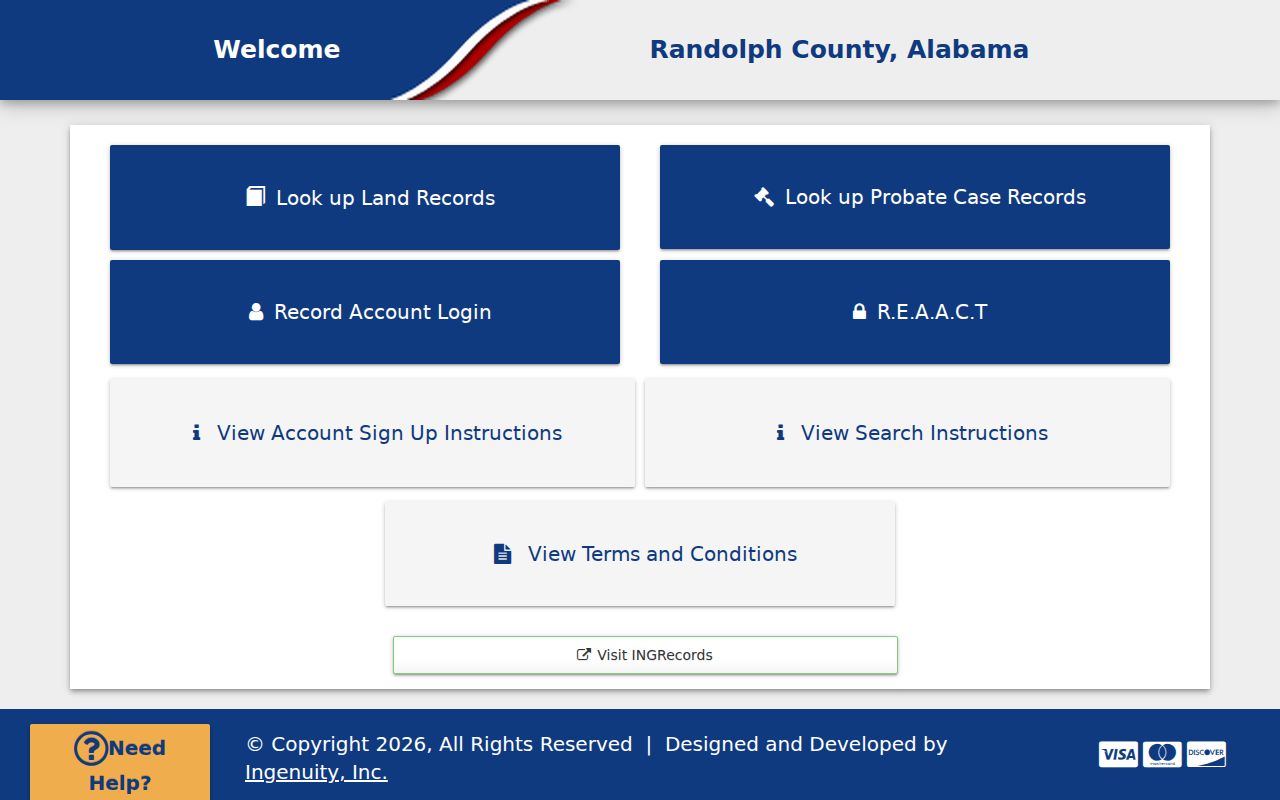
The image shows a portal view rather than a deed result. Names, coverage dates, and image fields must be checked during a live search.
Build Randolph's Deed Chain
Every deed has two key roles. The grantor transfers an interest; the grantee receives it. A chain of title is the linked sequence of transfers for the same land, and book and page point to a volume location while an instrument number is a unique filing reference. Record both whenever the index supplies them.
Work backward from a current owner lead. Continuity hinges on the legal description as much as the names, because one person can own several parcels and parcel IDs can shift after splits or combinations.
- Search the apparent owner as grantee and locate the newest acquisition deed.
- Record the grantor, grantee, recording date, execution date, legal description, and every book/page or instrument reference.
- Search that grantor as an earlier grantee, then compare acreage, lot, block, subdivision, and exceptions.
- Repeat the process, following corrections, cross-references, estate instruments, assignments, and releases.
- Write down the date and stopping point when the portal or index no longer supports the chain.
Randolph Deed Names Need Variants
A no-result screen is not proof that no deed exists. Try surname-first and given-name forms. Try initials. Also try punctuation variants, married names, corporate suffixes, trustee styles, and estate names. Search both grantor and grantee roles. The portal's Starts With control can widen a prefix. But official instructions do not describe it as a fuzzy or normalized search.
Business ownership warrants a second check. The Alabama business-entity search accepts entity name and entity number. It also accepts officer, agent, incorporator, or a reservation or registration ID. It confirms how an entity is styled. It does not reveal the beneficial owner of land. And it is no substitute for Randolph County deed records.
Note: Save every spelling, role, date range, instrument filter, and search date so another person can reproduce the result.
Plats Support Randolph Deeds
A deed may describe land by subdivision, lot, and block, or by metes and bounds. The plat is the recorded drawing behind that language. It can show the subdivision layout, lot arrangement, dedications, revisions, easements, and survey information. Randolph County Probate records plats and maps. The public GIS serves only as an orientation tool.
Carry the plat name and book or page from the current deed into the index. A modern street label may not appear in an old description. Search historical spellings and nearby transfers instead. The full Randolph County parcel map process can orient you to the present parcel. Keep in mind that a tax map never alters the legal text. The deed or recorded plat controls.
Randolph Recording Fees
Recording a deed in Randolph County starts with a modest fee schedule. The county's current recording-fee sheet charges $12 for a deed's first page. Each page after that costs $3. Indexing is built in. Two grantor names and two grantee names come with the base fee. Each added name costs $1. Cross-references also run $1 apiece.
Deed tax is separate. The sheet sets it at $1 per $1,000 of value, figured from the most recent assessment. The mortgage and deed interaction described there affects the calculation. That tax reflects assessed value, not market value. Resist using it to price a parcel.
Copies are another matter. The ING portal sells document images through its cart but publishes no per-document price. Recording fees say nothing about copy charges. Ask Probate to confirm the copy type and the total before mailing any funds.
Randolph Records Survived Fire
Fire shaped Randolph County's record history, and the details matter for deed research. The courthouse built in 1898 burned in August 1940. Yet county history credits a fireproof vault, installed in 1937, with saving most records. A replacement courthouse followed in 1941. So the fire did not wipe out a whole era of land records. Assuming it did can end a search too early.
Online coverage is a different question. The county dates to December 18, 1832. But that date says nothing about when the searchable index begins. The portal's 30-day My Documents retention is likewise no guide. It says nothing about how deep the digital records go. When a digital search runs dry, ask Probate for help. Probate can check the physical deed and plat indexes in the vault.
Older Randolph Deed Fallbacks
For an older or unindexed Randolph County deed, the Probate counter is the first fallback. Call 256-357-4933, or visit the courthouse at 1 Main Street South in Wedowee after confirming the current public entrance. Mailed questions go to P.O. Box 249, Wedowee, AL 36278. Say whether you need an index check, a plain copy, or a certified copy, and include names, dates, and any known references.
Two archival fallbacks exist beyond the courthouse. The FamilySearch Alabama Wills and Deeds collection is described statewide as covering roughly the 1700s through 2017. The Alabama Archives Randolph finding aid points to historical county and town files as well. Neither source proves a Randolph-specific volume range, so note the exact county filter, image status, and last verified instrument whenever you rely on one of them.
Request a Randolph Deed Copy
Ordering online takes a few steps. Create an account first. Then locate the index entry. Next, add the document to the cart. Complete the purchase after that. Keep the receipt and download link. Portal terms hold purchased material in My Documents for only 30 days. So download promptly. Label the file with the instrument type, book/page or number, names, and dates.
For in-person or mail access, contact the Randolph County Probate Judge. Confirm counter availability and certified-copy pricing with that office. A Commission open-records form is not the universal path here. Probate is the custodian of recorded land instruments.
Estate land can demand two connected searches. A will or probate case may name the heirs. The real-property transfer, though, may appear through an executor's deed, an administrator's deed, or an affidavit. It could also be a court order or another recorded instrument. Search the case clue and the land index together, and preserve the final recording reference. A family relationship alone never proves the parcel legally passed.
Recording is not a title opinion. The index shows filed instruments, but it cannot rule out an unrecorded interest, indexing error, or separate court matter.
A focused request gets better results. Give the clerk the indexed party names, the approximate recording date, and the instrument type. Include every known book/page or instrument number. When names are common, add the subdivision or legal-description clue. Before mailing payment, ask the office to confirm the copy type and fee. Ask about the payment method and delivery route, too. Keep the response with your search log. That record shows whether the search covered the web index, a physical index, or both. It also shows whether a certified copy was actually supplied.